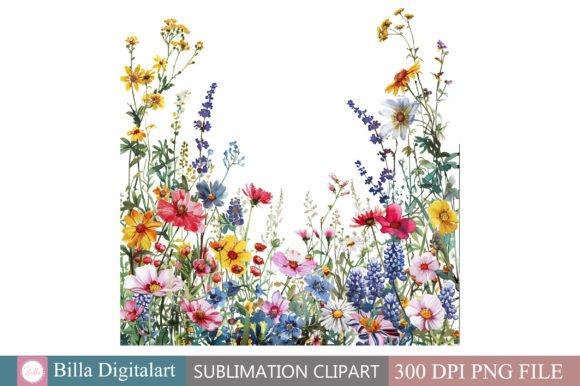
Evaluating Free Wild Flowers Floral Border Clipart for Professional Design Projects
In the landscape of digital design and print publishing, finding high-quality decorative assets that balance aesthetic appeal with technical reliability is a persistent challenge. Free wild flowers floral border clipart represents a specific niche within this ecosystem, offering organic, botanical framing elements without the associated licensing fees of premium stock libraries. For professionals ranging from freelance graphic designers to small business owners managing their own marketing collateral, these resources serve as a functional bridge between budget constraints and visual standards. However, the term "free" encompasses a wide spectrum of quality and utility. Understanding the practical value of these assets requires looking beyond the initial download to evaluate resolution, file integrity, stylistic consistency, and licensing compliance in real-world workflows.
Defining Characteristics and Technical Standards
Wild flower floral borders differ significantly from cultivated or tropical floral designs. They are characterized by irregularity, diverse species composition, and a sense of unmanicured growth. When evaluating free clipart in this category, the primary metric must be technical sufficiency. A visually pleasing thumbnail does not guarantee a usable asset. Professional application demands scrutiny of several key specifications:
- Resolution and Scalability: For print projects such as wedding invitations, book covers, or packaging, raster images (JPG/PNG) should ideally be 300 DPI at the intended print size. Vector formats (SVG/EPS/AI) are superior for borders because they allow infinite scaling without pixelation, which is critical when adjusting a border to fit varying document dimensions.
- Transparency and Layering: Usable border clipart must have a clean alpha channel if provided as a PNG. Jagged edges, white halos, or incomplete erasing render an asset useless for overlaying on colored backgrounds or textured paper stocks. True transparency allows for non-destructive editing and seamless integration into complex layouts.
- Color Mode Integrity: Many free resources are created in RGB for web display. Professionals intending to use these for commercial printing must verify color accuracy upon conversion to CMYK. Neon greens or oversaturated digital blues common in amateur wild flower illustrations often shift drastically in print, requiring significant color correction time.
- Stylistic Cohesion: A functional border set should include matching corners, horizontal segments, and vertical segments drawn with consistent line weight, shading style, and botanical accuracy. Mismatched elements break the visual flow and expose the project as a composite of disparate freebies rather than a cohesive design.
Practical Applications Across Industries
The versatility of free wild flowers floral border clipart extends across multiple professional domains, though its suitability depends heavily on the specific context of the project. Educators and homeschool curriculum developers frequently utilize these assets to create engaging worksheets, nature study journals, and classroom signage. In this context, the informal, hand-drawn aesthetic often associated with free wild flower art aligns perfectly with pedagogical goals of fostering connection to nature. The zero-cost factor is particularly relevant here, where budgets are tight and volume is high.
For entrepreneurs and marketers, the application is more nuanced. Small businesses in the wellness, organic food, sustainable fashion, or artisan craft sectors can leverage these borders to reinforce brand identity. A lavender and chamomile border on a product label immediately signals natural ingredients and eco-consciousness. However, professionals must exercise caution. Generic free clipart can sometimes signal "amateur" to discerning consumers. To mitigate this, designers should treat free borders as raw material rather than finished solutions. Adjusting hue, adding texture overlays, or combining multiple elements can transform a generic freebie into a proprietary brand asset that feels custom and intentional.
Publishers and self-published authors represent another significant user base. Poetry collections, nature memoirs, and cozy mysteries often require chapter headers and page borders that evoke a pastoral atmosphere. Free wild flower clipart provides an accessible solution for interior formatting. Yet, consistency is paramount in book design. Using different free borders for each chapter can look disjointed. Professionals should select a single, comprehensive set or curate a limited palette of elements to maintain typographic and visual rhythm throughout the manuscript.
Navigating Licensing and Commercial Viability
The most critical consideration for any professional using free assets is intellectual property rights. "Free to download" is not synonymous with "free to use commercially." Misunderstanding this distinction can lead to legal exposure and reputational damage. When sourcing free wild flowers floral border clipart, rigorous verification of license terms is mandatory.
- Creative Commons Zero (CC0) / Public Domain: These are the safest options for commercial work. They permit modification, redistribution, and commercial use without attribution. However, true public domain botanical art is often vintage (pre-1928), which may offer engraving styles rather than modern vector aesthetics.
- Attribution Required (CC BY):strong> Many high-quality free resources fall under this license. While legally permissible for commercial projects, the requirement to credit the artist can be aesthetically disruptive on product packaging or minimalist branding. Professionals must weigh whether the attribution placement compromises the design integrity.
- Personal Use Only: A significant portion of free floral clipart is restricted to non-commercial projects. Using these for client work, Etsy listings, or monetized blogs constitutes copyright infringement. Always check the specific license file included in the download package, not just the website description.
- Model and Property Releases: While less common for illustrated borders, photographic floral borders may require releases if recognizable private gardens or trademarked plant varieties are depicted. Illustrations generally avoid this issue but introduce concerns about derivative works if the original artist prohibits modifications.
Assessing Quality Limitations and Workflow Integration
Despite their advantages, free wild flowers floral border clipart presents inherent limitations that professionals must manage. One frequent issue is anatomical inaccuracy. Botanical illustration requires scientific precision; many free assets depict generic "flower shapes" rather than identifiable species. For projects targeting knowledgeable audiences—such as gardening guides, herbalism textbooks, or conservation materials—this lack of specificity undermines credibility. In such cases, investing in scientifically accurate paid assets or commissioning custom work is often necessary.
Another limitation is file organization. Premium assets typically come with organized folders, naming conventions, and documentation. Free downloads are often unstructured zip files containing mixed formats, duplicate resolutions, and missing metadata. This imposes an administrative overhead: renaming files, converting formats, creating swatches, and documenting sources for future reference. Factoring this preparation time into project estimates is essential for maintaining profitability.
Furthermore, the saturation of popular free platforms means certain wild flower borders become ubiquitous. Overused assets can make distinct brands appear identical. Professionals should conduct reverse image searches before committing to a widely available free border, especially for flagship products or long-term campaigns. If a border appears on dozens of competing websites, its effectiveness as a differentiator is nullified. Customization becomes not just an aesthetic choice but a strategic necessity.
Strategic Recommendations for Sustainable Use
To maximize the value of free wild flowers floral border clipart while minimizing risk, adopt a systematic approach to asset management. Build a curated internal library rather than relying on ad-hoc downloads. Vet each addition for technical quality, license clarity, and stylistic alignment with your brand or typical client work. Maintain a spreadsheet tracking source URLs, license types, attribution requirements, and modification permissions. This documentation protects against future disputes and streamlines workflow during deadline-driven projects.
Consider free clipart as a starting point for hybrid creation. Combine free botanical elements with original typography, custom textures, or AI-generated backgrounds to create unique compositions that cannot be replicated by others using the same source files. This approach honors the spirit of open-source creativity while delivering professional-grade results that meet client expectations and market standards.
Ultimately, free wild flowers floral border clipart occupies a valuable position in the creative toolkit. It democratizes access to natural aesthetics and enables rapid prototyping, educational content creation, and budget-conscious design. Its worth is determined not by its price tag but by the discernment applied during selection, the diligence exercised in licensing verification, and the skill brought to its integration. When approached with professional rigor, these resources transcend their origins as freebies to become legitimate components of polished, effective visual communication. The key lies in treating them with the same evaluative standards applied to paid assets, ensuring that cost savings never come at the expense of quality, legality, or creative integrity.